Yongqing Jiang (江永清) — SCU-NTU Joint PhD Student in AI for Civil Engineering
👤 About Me
Hi there, I’m Yongqing Jiang, a joint PhD student at  Sichuan University (SCU) and
  Nanyang Technological University (NTU) under the supervision of Prof. Kaoshan Dai and Prof. Zhiqi Shen.
My research resides at the intersection of Civil Engineering and Computer Science.
Prior to my doctoral studies at SCU and NTU, I gained significant research experience at the Shandong Key Laboratory of Intelligent Building Technology.
Nanyang Technological University (NTU) under the supervision of Prof. Kaoshan Dai and Prof. Zhiqi Shen.
My research resides at the intersection of Civil Engineering and Computer Science.
Prior to my doctoral studies at SCU and NTU, I gained significant research experience at the Shandong Key Laboratory of Intelligent Building Technology.
My research interest focuses on applying artificial intelligence and deep learning to intelligent infrastructure systems, which can be divided as follows:
- Structural Health Monitoring (SHM).
- AI and Data Science in Engineering.
- Large Language Models (LLMs) & Vision-Language Models (VLMs).
- Intelligent and Resilient Infrastructures.
Email: yongqingjiang97@gmail.com
Note: I am currently open to academic opportunities. Please feel free to contact me regarding any available positions.
🔥 News
- 2026.08 🎉🎉 Jelu presented our paper "Rethinking Scientific Modeling: Toward Physically Consistent and Simulation-Executable Programmatic Generation" at KDD 2026 (Aug 9).
- 2026.08 🎉🎉 Our paper "Post-earthquake recovery assessment of indoor unanchored non-structural systems using computer vision techniques" has been published in Safety Science.
- 2026.04 🎉🎉 Our paper "A transformer-based method for seismic rocking response prediction of unanchored non-structural components" has been published in Journal of Building Engineering.
- 2026.02 🎉🎉 Our paper "An entropy-like computer vision method for post-earthquake damage assessment of nonstructural components within indoor scenes" has been published in Soil Dynamics and Earthquake Engineering.
- 2026.02 🎉🎉 Our paper "Rethinking Scientific Modeling: Toward Physically Consistent and Simulation-Executable Programmatic Generation" was covered by the WeChat media account MindChain.AI.
- 2026.01 🎉🎉 Our paper "Large language model for post-earthquake structural damage assessment of buildings" has been selected as the Featured Cover of Computer-Aided Civil and Infrastructure Engineering — the only featured cover of the year and an Editor-in-Chief's Choice, recommended by Prof. Hojjat Adeli.
- 2025.12 🎉🎉 Honored to lead our team to win the National Second Prize in the 2025 First China Graduate Intelligent Construction Innovation Competition.
- 2025.11 🎉🎉 Our paper "Large language model for post-earthquake structural damage assessment of buildings" (sole first author, sole first affiliation) was featured in the news of the College of Architecture and Environment, Sichuan University.
📝 Selective Publications
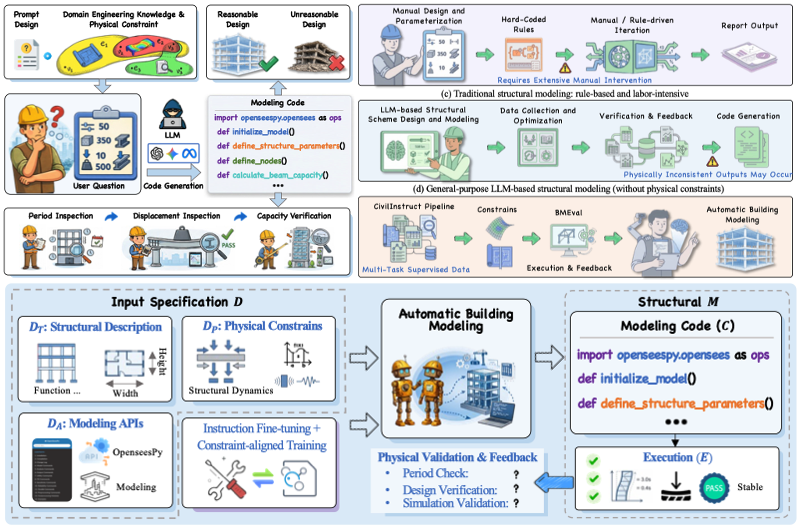
Yongqing Jiang, Jianze Wang, Zhiqi Shen, Kaoshan Dai, Haoran Luo
KDD, 2026
- A framework pairing the CivilInstruct dataset with the MBEval benchmark to make LLM-generated structural modeling code physically consistent and simulation-ready.
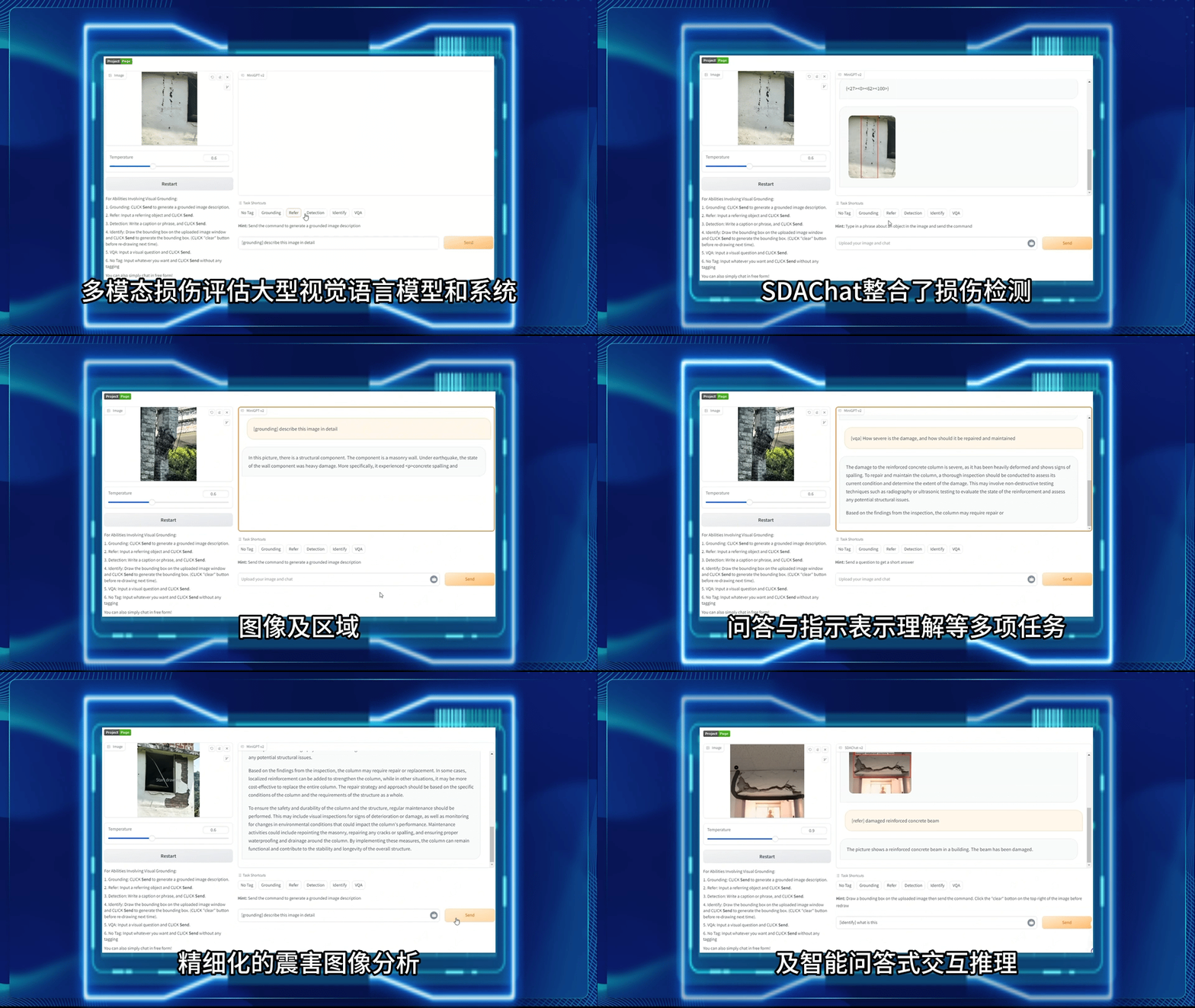
Yongqing Jiang, Jianze Wang, Xinyi Shen, Kaoshan Dai, Qingzi Ge
Automation in Construction, 2026
- A multitask unified vision-language model for post-earthquake structural damage assessment, built on instruction-based multi-task learning and a large-scale multi-attribute image–text dataset.
Large language model for post-earthquake structural damage assessment of buildings
Yongqing Jiang, Xinyi Shen, Jianze Wang, Kaoshan Dai
Computer-Aided Civil and Infrastructure Engineering, 2025
- SDA-Chat, a multimodal LLM that automates post-earthquake structural damage assessment via multi-round vision-language interaction, achieving 83.04% accuracy.
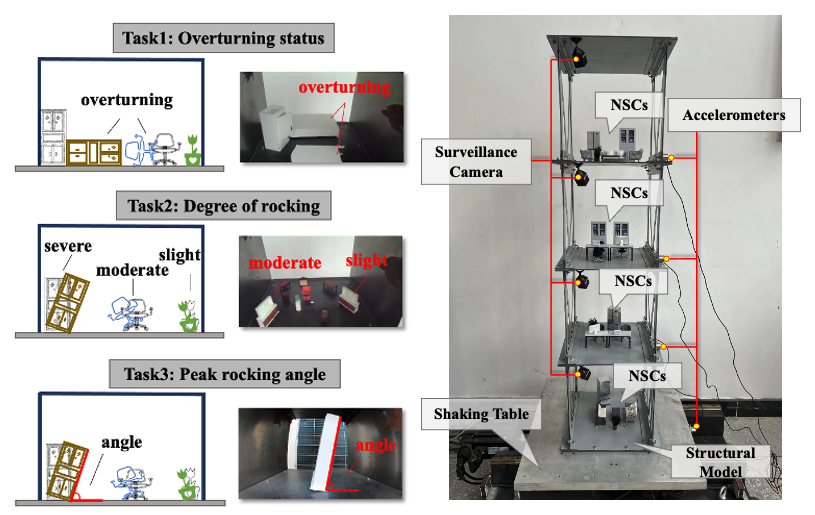
Yongqing Jiang, Jianze Wang, Weiwei Chen, Kaoshan Dai
Engineering Structures, 2025
- A vision-based machine-learning framework that infers peak floor acceleration (PFA) ranges from the rocking responses of freestanding non-structural components, with 84%–94% accuracy.
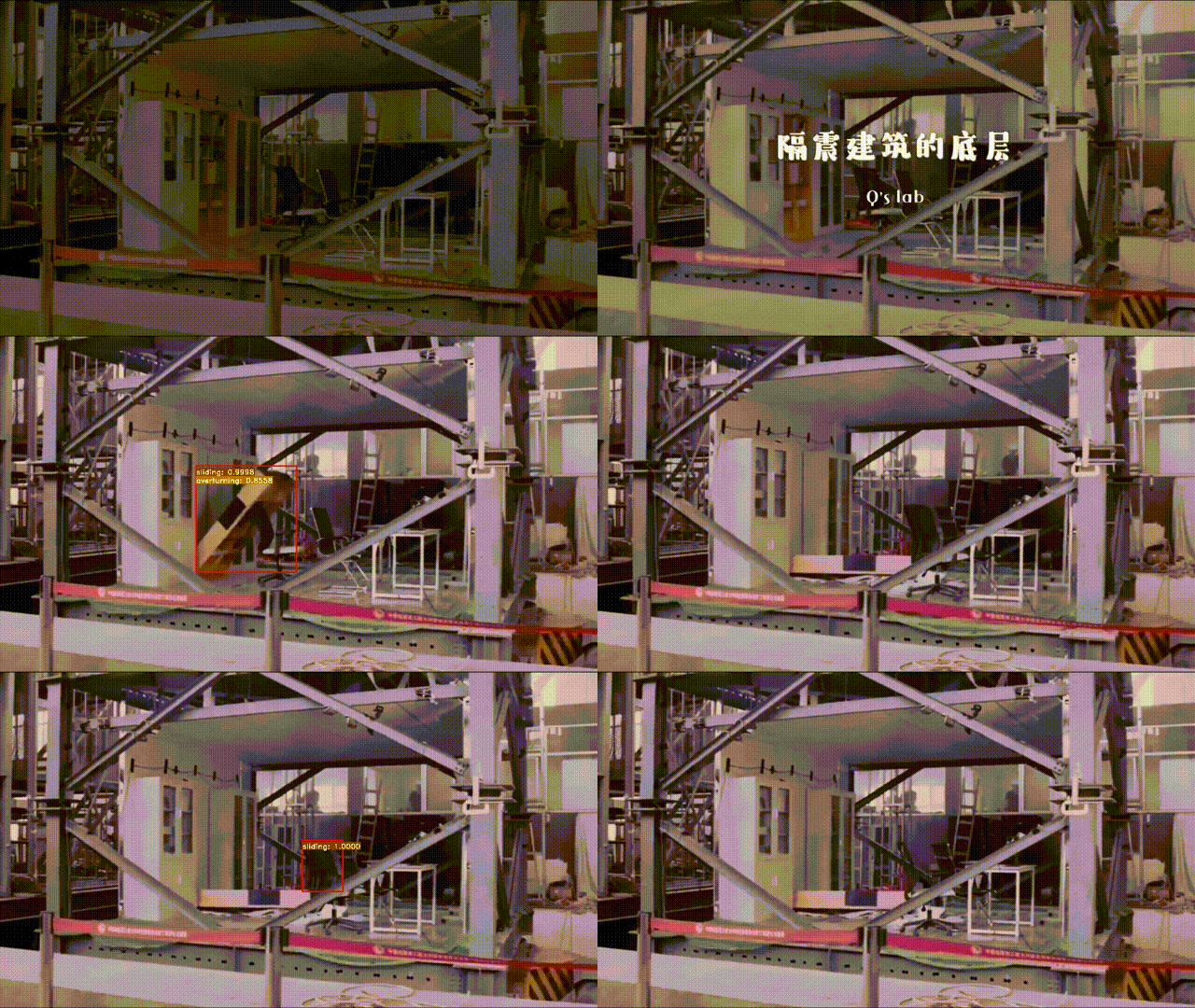
Yongqing Jiang, Jianze Wang, Xingquan Guan, Kaoshan Dai
Engineering Structures, 2024
- TPViT-DMSR, a two-pathway vision transformer that recognizes seismic damage states of freestanding non-structural components from video, reaching 74.87% mAP.
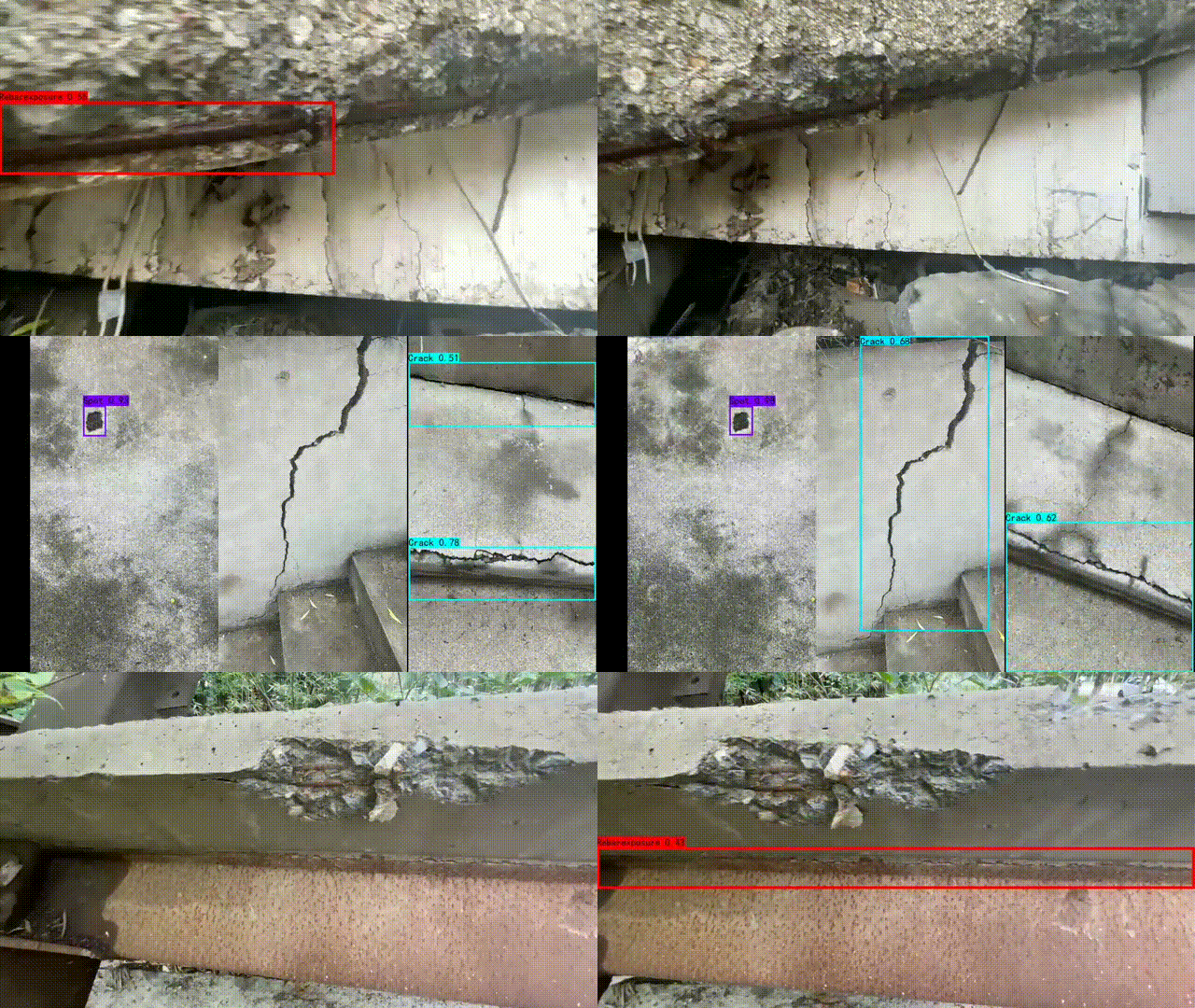
A deep learning approach for fast detection and classification of concrete damage
Yongqing Jiang, Dandan Pang, Chengdong Li
Automation in Construction, 2021
- A fast deep learning pipeline that detects and classifies concrete damage in images.
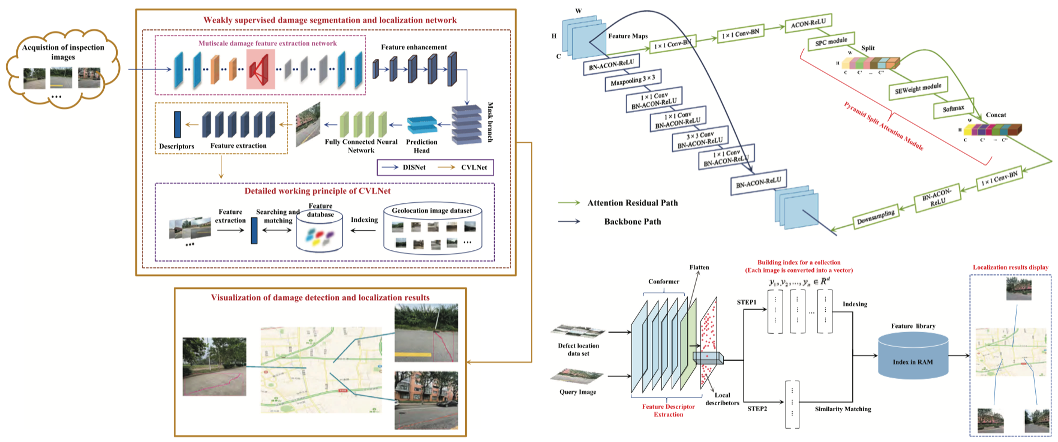
A method of concrete damage detection and localization based on weakly supervised learning
Yongqing Jiang, Dandan Pang, Chengdong Li, Jianze Wang
Computer-Aided Civil and Infrastructure Engineering, 2023
- A CNN-based framework for automated concrete defect detection and sensor-free geographical localization, with 83.69% localization accuracy.
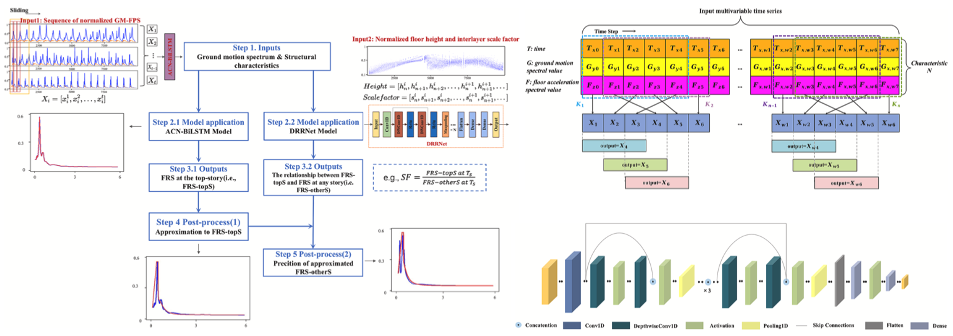
An adapted LSTM-DRRNet approach for predicting floor acceleration response spectrum
Jianze Wang, Yongqing Jiang, Qinyong Huang, Xingquan Guan, Kaoshan Dai
Engineering Structures, 2023
- An ACN-BiLSTM + DRRNet deep-learning framework for generalized, efficient prediction of nonlinear floor response spectra, with 97.29% accuracy.
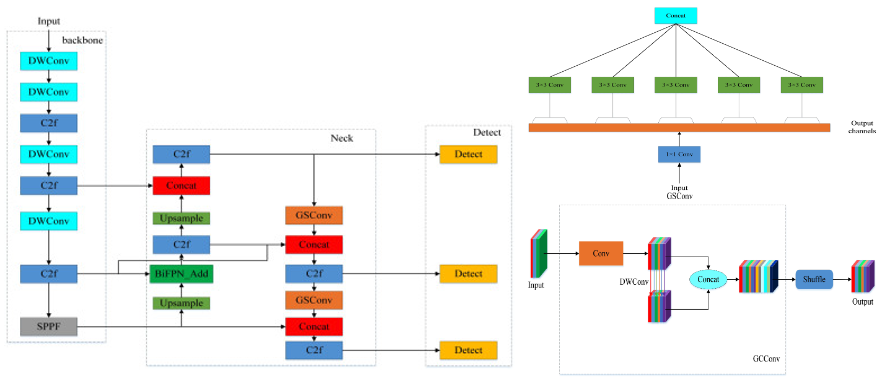
Yukang Cao, Dandan Pang, Qianchuan Zhao, Yi Yan, Yongqing Jiang, Chongyi Tian, Fan Wang, Junlin Li
Engineering Applications of Artificial Intelligence, 2024
- YOLOv8-GD, a lightweight photovoltaic defect detector (DW-Conv/GSConv backbone with BiFPN), cutting model size by 16.7% while improving mAP@0.5 by 4.2%.
📜 Selective Patents
- 2026 J. Wang, Y. Jiang, K. Dai. "A Vision-based Seismic Damage Identification Method for Freestanding Non-structural Components." Chinese Invention Patent, No. ZL202211256985.5 (Authorized).
- 2025 J. Wang, Y. Jiang, K. Dai. "Intelligent Seismic Damage Assessment Method for Buildings Based on Multimodal Large Language Models." Chinese Invention Patent, No. ZL202311278623.0 (Authorized).
- 2025 J. Wang, Y. Jiang, K. Dai. "A Deep Learning-based Method for Predicting Nonlinear Floor Acceleration Response Spectra." Chinese Invention Patent, No. ZL202310182776.9 (Authorized).
- 2023 J. Wang, Y. Jiang, K. Dai. "Seismic Damage Assessment Method for Buildings Based on Video-Identified Damage of Non-structural Components." Chinese Invention Patent, No. ZL202210631442.0 (Authorized).
- 2022 D. Pang, Y. Jiang, C. Li. "Intelligent Detection System and Method for Building Damage Based on Integrated Vision." Chinese Invention Patent, No. ZL202110740932.X (Authorized).
- 2022 D. Pang, Y. Jiang, C. Li. "Detection Method and System for Intelligent Traffic Electronic Prompting Devices Based on Multifeature Vision." Chinese Invention Patent, No. ZL202110769715.3 (Authorized).
🎖 Honors and Awards
- 2025 China Scholarship Council (CSC) Scholarship for Joint Ph.D. Students (Fully Funded / National Level)
- 2025 Nominee for the Young Elite Scientist Sponsorship Program (PhD Student Special Track)
- 2025 Sichuan University PhD Innovation Scholarship (Top 1%)
- 2024 Sichuan University PhD Innovation Scholarship (Top 1%)
- 2024 Outstanding Graduate of Sichuan University (Top 1%)
- 2024 Sichuan University First-Class Scholarship (Ranked 1st in Major)
- 2022 National Scholarship by Ministry of Education of China (Top 1%)
- 2021 Outstanding Graduate of Shandong Province (Top 1%)
- 2021 First Prize of Outstanding Graduate Achievement Award in Shandong Province (Top 3%)
🏆 Competitions
- 2025 National Second Prize, Inaugural China Graduate Intelligent Construction Innovation Competition — Intelligent Seismic Damage Identification and Assessment Technology for Buildings (Leader)
- 2021 Regional Third Prize (North China), China Graduate Electronic Design Competition — Real-time Portable Concrete Defect Detection System based on YOLOv4 (Leader)
💬 Invited Talks
- 2024.04 "A data-driven approach for estimating peak floor response based on damage of non-structural components." The 4th International Conference on Vulnerability and Risk Analysis and Management (ICVRAM-ISUMA 2024), Tongji University, Shanghai, China.
- 2023.05 "Video comprehension-based approach for seismic damage recognition of freestanding non-structural components." The 3rd Academic Conference on Computational and Simulation Technologies in Civil Engineering, Guangxi University, Nanning, China.
🤝 Conference Experience
- 2024.12 The 2nd Innovation Forum on Wind Disaster Mitigation and Wind Energy Utilization, Chengdu, China — supported forum organization, participant guidance, and academic session assistance.
- 2024.11 The 14th China-Japan Structural Engineering Technology Exchange Conference, Chengdu, China — assisted with conference organization, participant reception, and on-site coordination.
- 2024.05 The 10th Technical Exchange Conference on Seismic Retrofitting and Renovation (Seismic Resistance and Disaster Prevention Branch, Architectural Society of China), Chengdu, China — supported attendee reception, venue coordination, and on-site assistance for technical sessions.
🚀 Projects
- NSFC Intelligent Recognition of Indoor Seismic Damage Characteristics and Building Resilience Assessment Based on Video Understanding — Key Researcher
- NSFC Mechanisms and Applications of Fiber Bragg Grating–Based Acoustic Emission Sensing for Concrete Durability Damage Monitoring — Key Researcher
- NSFC Multi-Model Ensemble–Driven Precise Profiling of Office Building Operational States and Integrated Energy-Efficiency Optimization — Key Researcher
- NSFC Swarm-Intelligence–Based Bio-Inspired Control of Robotic Fish Schools for Navigation in Unknown Aquatic Environments — Key Researcher
- NSFC Coupled Optimization and Dual Control of Vibration and Wind-Induced Responses for Novel Structural Systems of Ultra-High Wind Power Towers — Key Researcher
- Provincial Outstanding Young Innovation Team in Artificial Intelligence and Building Intelligence, Shandong Provincial Higher Education Institutions — Key Researcher